
Pediatric Eye Care
Support your child's highest potential.
Healthy vision is a big part of how children learn, play and grow.
Vision develops quickly in childhood and is tied to milestones like hand-eye coordination and reading. Many problems can only be found in a comprehensive eye exam. We examine children as young as 1 year old.
Headaches after school or homework can come from the eyes. See headaches and eye strain.
New in October 2026
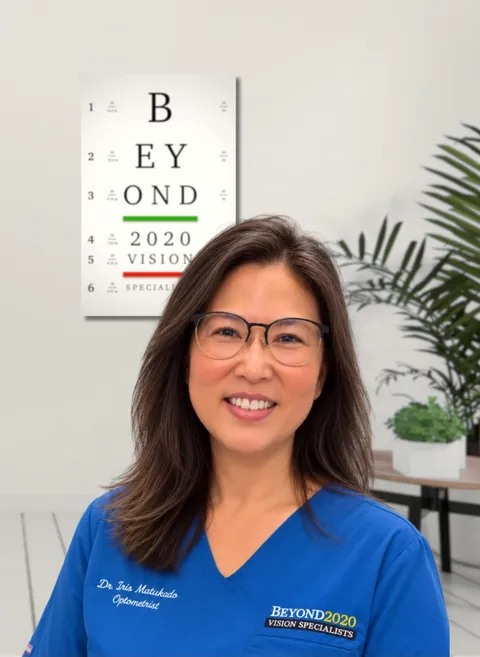
Welcome, Dr. Iris Matsukado
Beyond 2020 brings in pediatric optometry. Dr. Iris Matsukado (“Dr. Mats”) joined our team in October 2026 to lead pediatric eye care at our Odessa office, with more than 30 years of experience caring for children’s eyes. Read the announcement.
Eye exams for children from age 1
Your child doesn't need to know their letters to have a complete eye exam. Dr. Iris Matsukado, known to families as “Dr. Mats,” focuses on pediatric eye care and sees babies, toddlers and school-age kids starting at 1 year old at our Odessa office.
For little ones, the exam uses pictures, lights, toys and simple tests that measure how the eyes focus and work together without asking a child to read. Dr. Mats checks for lazy eye, crossed or wandering eyes, nearsightedness, farsightedness and astigmatism, and for focusing and eye-teaming problems that can make reading harder. She completed a residency in pediatrics, sports vision and vision therapy, and has more than 30 years of experience helping kids feel comfortable in the exam chair.
Sports vision and binocular vision
Sports vision. Young athletes rely on more than 20/20. Dr. Mats looks at the visual skills a sport depends on, like depth perception, eye tracking and eye-hand coordination, and recommends sports eyewear, contact lenses or protective eyewear. She has provided vision care for professional baseball teams and served for 20 years with the American Optometric Association’s Sports Vision team at the Junior Olympics.
Binocular vision. When the eyes don’t aim, focus or move together well, reading and homework can bring headaches, tired eyes, double vision or words that seem to move, even in a child who sees 20/20. Dr. Mats evaluates eye teaming, focusing and eye movements and explains the treatment options for your child. These visits are available for adults too, at our Odessa office.
Family visits and Beyond Kids
We see parents and kids back to back in the same visit, with no extra appointments to schedule. We’re open Saturdays, and Saturday walk-ins are always welcome. Booking ahead just gets you a set time.
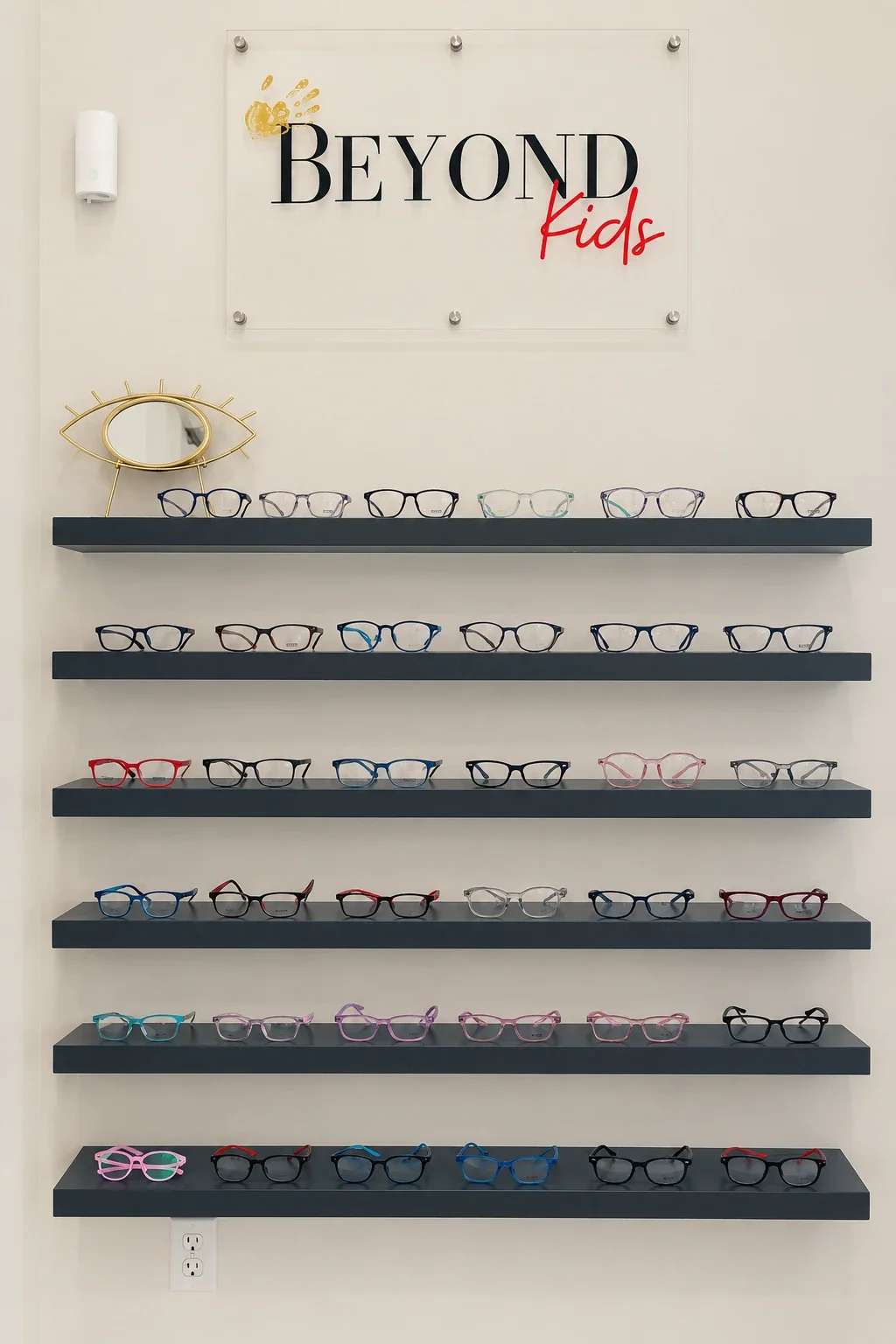
Beyond Kids, the kids' frame section at our Odessa and East Lake offices, has frames sized for children in lots of colors. At Odessa, most single-vision kids' glasses are made while you wait in our lab, in lightweight, impact-resistant polycarbonate lenses; glasses ordered at East Lake are usually ready in 1 to 3 days.
Signs your child may have a vision problem
Vision problems in kids aren't always obvious. Watch for a child who:
- Avoids reading or close-up activities like coloring and puzzles
- Squints, holds books very close or sits close to the TV
- Complains of headaches or tired eyes
- Has a short attention span or seems easily distracted
- Covers one eye or tilts their head to focus
- Is sensitive to light or has trouble with coordination
Common childhood eye conditions
When should kids have eye exams?
School screenings aren't the same as an eye exam. A child can pass a screening and still have a problem only an eye doctor can find. Recommended exams:
- Between 6 and 12 months of age
- At least once between ages 3 and 5
- Before first grade
- Every year through the school years
We see children as young as 1 year old. If you notice any of the signs above, don't wait for a scheduled check-up.
Common questions
How young can my child have an eye exam?
We examine children as young as 1 year old. Eye doctors recommend a first exam between 6 and 12 months, another between ages 3 and 5, and yearly exams through the school years.
My child can't read letters yet. How do you test their vision?
Young children are tested with pictures, lights and simple tests that measure how the eyes focus and work together. None of them require a child to know their letters or answer questions perfectly.
Isn't a school vision screening enough?
No. A screening only checks how clearly a child sees at a distance. A comprehensive eye exam also checks eye health, focusing, eye teaming and conditions like lazy eye that a screening can miss.
Why is early detection of lazy eye important?
Lazy eye (amblyopia) responds best to treatment while vision is still developing, usually before about age 8. Finding it early gives treatment the best chance to work.
Can vision problems affect my child's reading and school work?
Yes. Trouble focusing up close or keeping the two eyes working together can cause headaches, skipped lines and avoiding reading, even when a child sees the eye chart clearly.
Will my child's eyes be dilated?
Often, yes. Dilating drops let the doctor see the whole inside of the eye and measure the prescription accurately in young children whose focusing muscles are very active. The effect wears off within several hours.
Can my whole family be seen in one visit?
Yes. We see parents and kids back to back in the same visit, with no extra appointments to schedule. We’re open Saturdays, and Saturday walk-ins are always welcome. Booking ahead just gets you a set time.
Do you have glasses frames for kids?
Yes. Beyond Kids, the kids' frame section at our Odessa and East Lake offices, has frames sized for children in lots of colors. At Odessa, most single-vision kids' glasses are made while you wait.
“Beyond 2020 vision has been so great for my two boys. Not only are they efficient they were able to have our glasses ready in house. We can’t thank them enough for taking care of our kids.”Melanie W. · Odessa, Google review
Medically reviewed by Dr. Christopher Tumolo, O.D., L.D.O. · Last reviewed
Sources
This page is general education, not a diagnosis. Same-day appointments are available during office hours.