
For Coaches, Athletic Trainers & School Nurses
Helping students see and play safely.
You see students every day, so you're often the first to notice when something isn't right with their eyes.
Here's what to do after a failed screening, signs to watch for, sports eye safety and eye injury first aid, and how our team can help.
A failed screening is a starting point
School screenings are a quick, helpful check, but they're not an eye exam. Most look at how clearly a student sees across the room. Many don't check focusing up close, how the two eyes work together, or eye health.
The American Optometric Association notes that screenings may miss as many as 60% of children with vision problems, and that a child who passes a screening should still have a comprehensive eye exam (AOA). The American Academy of Ophthalmology advises a comprehensive exam when a child fails a screening, the screening can't be finished, or a school nurse refers them (AAO).
Signs a student may have a vision problem
Kids rarely say they can't see. They often think everyone sees the way they do. Watch for a student who (AOA):
- Complains of tired eyes, discomfort or frequent headaches
- Rubs their eyes or blinks a lot
- Avoids reading and close work, or has a short attention span
- Covers one eye or tilts their head
- Holds books or screens very close
- Has an eye that turns in or out, or says they see double
- Loses their place when reading or has trouble remembering what they read
Some of these look a lot like attention problems. A full eye exam helps sort out whether vision is part of the picture. Learn more about vision and learning.
Sports eye safety
Basketball is a leading cause of sports eye injuries in the U.S., followed by baseball and softball, according to the American Academy of Ophthalmology. Most serious sports eye injuries can be prevented with the right protective eyewear (AAO).
- Basketball, racquet sports, soccer and field hockey: sports goggles with polycarbonate lenses (AAO)
- Look for ASTM F803 on the label. Prevent Blindness advises that eye guards and sports eyewear be labeled as meeting ASTM F803 (Prevent Blindness)
- Baseball and softball: batting helmets with a polycarbonate face shield for batters and base runners, and certified protective eyewear for fielders (AAO; Prevent Blindness)
- Ice hockey and lacrosse: a helmet with a polycarbonate face mask or wire shield (AAO)
- Regular glasses aren't protection. Everyday glasses can shatter and make an injury worse (AAO)
- Athletes with poor vision in one eye should talk with their eye doctor about protection before playing a high-risk sport
Eye injury first aid basics
Based on guidance from the American Academy of Ophthalmology (AAO). Some serious injuries don't look serious at first, so every eye injury should be checked.
- Don't rub the eye or press on it. Get the athlete seen right away.
- Hit by a ball, elbow or stick: a small cold compress held gently, with no pressure. Even a light blow can cause a serious injury inside the eye. Get the athlete seen right away.
- Cut eye, or something stuck in the eye: don't try to remove it and don't rinse. Tape a shield over the eye (the bottom of a paper cup works) without pressing on it. No aspirin or ibuprofen. Call 911 or go to the emergency room right away.
- Chemical splash: flush the eye right away with plenty of clean water, then get emergency care right away.
- Dirt or grit: don't rub. Let the athlete blink, and rinse with clean water or saline. Get the athlete seen right away.
How we help students and teams
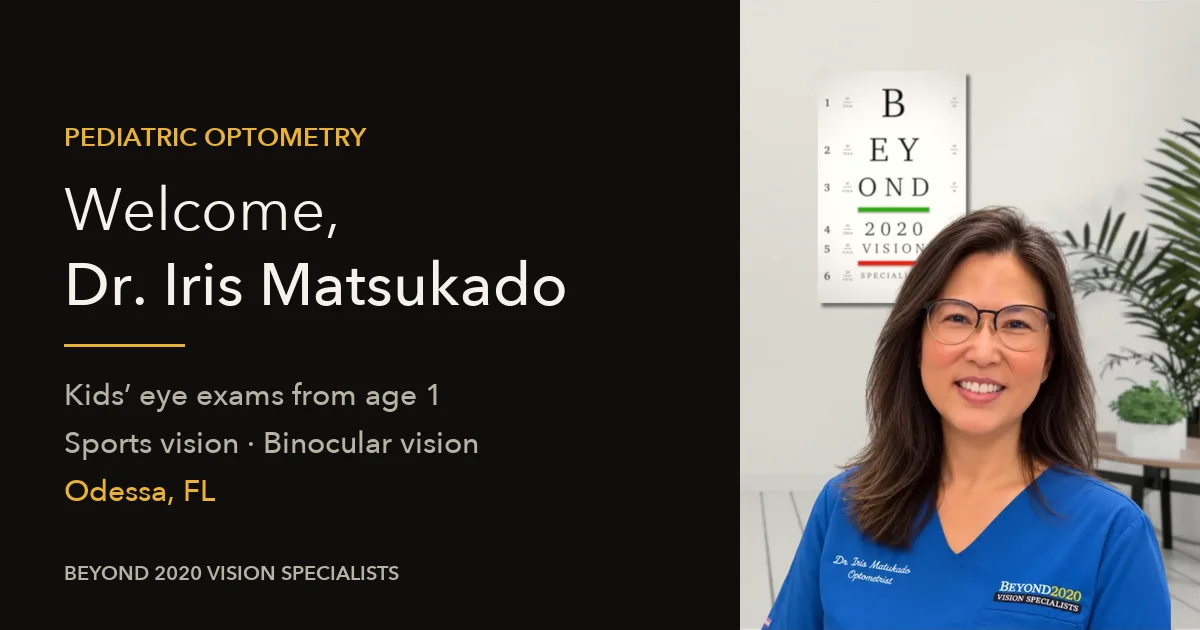
- Pediatric eye exams from age 1. Dr. Iris Matsukado ("Dr. Mats") leads our pediatric eye care at our Odessa office.
- Sports vision. Dr. Mats looks at the visual skills a sport depends on, like depth perception, eye tracking and eye-hand coordination. She has cared for professional baseball players and served for 20 years with the American Optometric Association's Sports Vision team at the Junior Olympics.
- Prescription sports goggles for athletes who need glasses to see, in impact-resistant polycarbonate.
- Eye reports for school and 504 plans. After an exam, we can write up findings and recommendations for the school team. See forms and letters.
- Same-day care for eye injuries at our Odessa and East Lake offices.
Talk with your team
Coaches, athletic directors, school nurses and PTAs: we're happy to talk with your team or parent group about vision and eye safety — call our Odessa office at (813) 926-5993.
Common questions
A student failed a school vision screening. What should happen next?
A full, comprehensive eye exam. The American Academy of Ophthalmology advises one when a child fails a screening, and the American Optometric Association notes a child who passes a screening should still have one. Dr. Mats sees children from age 1 at our Odessa office.
What eyewear should young athletes wear?
Sports goggles with polycarbonate lenses for basketball, racquet sports, soccer and field hockey, labeled as meeting ASTM F803. In baseball and softball, batters wear helmets with a polycarbonate face shield and fielders wear certified protective eyewear.
Are regular glasses OK for sports?
No. Everyday glasses aren't built to take a hit and can shatter, which can make an injury worse. Athletes who need a prescription can get prescription sports goggles.
What should I do if an athlete is hit in the eye?
Don't rub or press on the eye. Hold a small cold compress gently with no pressure, and don't try to remove anything stuck in the eye. Get the athlete seen right away. Call 911 for a cut or punctured eye, an object in the eye or a chemical splash.
Can you write an eye report for school or a 504 plan?
Yes. After an eye exam, we can write up our findings and recommendations for the student's school team. Ask at the visit or call our Odessa office.
Will Dr. Mats speak to our team or parent group?
We're happy to talk with your team or parent group about vision and eye safety. Call our Odessa office at (813) 926-5993.
Medically reviewed by Dr. Christopher Tumolo, O.D., L.D.O. · Last reviewed
Sources
- American Optometric Association: School-aged vision, 6 to 18 years
- American Academy of Ophthalmology: Eye Screening for Children
- American Academy of Ophthalmology: Sports Eye Safety
- Prevent Blindness: Sports Eye Safety
- American Academy of Ophthalmology: Recognizing and Treating Eye Injuries
This page is general education, not a diagnosis. Same-day appointments are available during office hours.